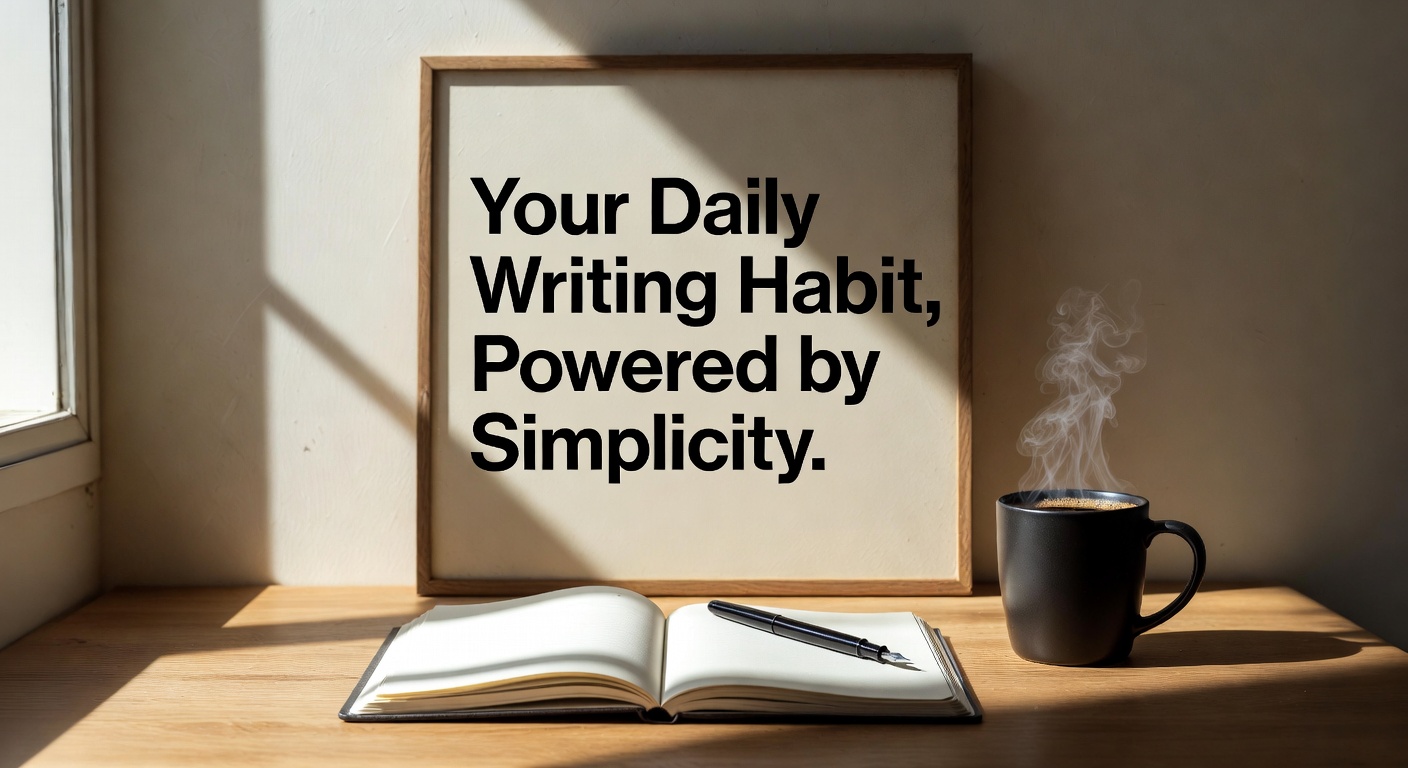
Most writing tools promise to eliminate the blank page, but they usually just add more menus to click through. You sit down to draft a blog post, open a dense editor, and suddenly you're tweaking formatting or navigating feature panels instead of actually writing. The friction kills the momentum. Building a consistent routine requires something different: an interface that gets out of your way. That's the core premise behind Your Daily Writing Habit, Powered by Simplicity—a concept that Writely Studio leans into heavily.
Stripping the Friction from Rough Concepts
Writely Studio doesn't try to be a full-scale publishing platform. It focuses on the gap between a scattered idea and a structured draft. You might have three bullet points and a vague headline sitting in a notes app. Pasting those into Writely and asking it to expand the structure gives you an immediate skeleton. It doesn't hand you a polished final piece, but it fills the void so you have something to react to, edit, and reshape. This is where the tool actually earns its keep.
Consider a common scenario: you need to write a script for a short video. You have the hook and the call-to-action, but the middle section is a mess. Instead of staring at the cursor, you drop the fragments into the AI writing assistant. Writely bridges the gap, suggesting transitions and organizing the flow. You still have to rewrite the clunky AI phrasing, but you're modifying an existing structure rather than building from zero. That shift—from creation to editing—makes sitting down to write feel significantly less daunting.
Where the Minimalist Approach Works (and Where It Falls Short)
Simplicity in a writing tool is a double-edged sword. Writely's clean interface is a massive advantage when you just need to dump thoughts and organize them. There are no complex SEO scoring panels or dense formatting toolbars demanding your attention. You write, you prompt, you edit. It keeps the focus on the text, which is exactly what you need to maintain a daily writing habit without burning out on tool mechanics.
But that same minimalism means it lacks the heavy-duty features some workflows demand. If your process involves granular keyword density tracking, real-time SERP analysis, or intricate content briefs built from scratch, Writely will feel under-equipped. It's not competing with SurferSEO or Clearscope. It also isn't a substitute for a dedicated grammar checker. The AI handles structure and expansion well, but it can still generate generic phrasing or awkward transitions that require a sharp human eye to catch.
If you rely on deep data integrations to shape your content, you might find the tool too isolated. Writely assumes you already have the core idea and just need help articulating it. Those looking for an AI to do the top-level research and outline generation from a single keyword will likely need a more robust, feature-heavy platform—or at least a companion tool to handle the research phase.
Making the Daily Habit Practical
The real test of any writing tool is whether you actually open it tomorrow. Writely Studio makes this easier by shrinking the time between thinking and drafting. An SEO content writer staring down a weekly quota can take a rough outline, run it through Writely, and have a workable 1,000-word draft in twenty minutes. The next forty minutes are spent tightening the prose, adding specific data, and stripping out the AI-isms. The math works: an hour per piece instead of three. When the resistance to starting is that low, maintaining a daily writing habit becomes a practical reality rather than an aspirational goal.
Building Your Daily Writing Habit, Powered by Simplicity isn't about finding a magic button that writes perfectly for you. It's about removing the barriers that keep you from writing at all. Writely Studio does a solid job of keeping the friction low, provided you don't need a Swiss-army-knife tool. Use it to get the words out, then rely on your own judgment to make them worth reading.
Comments
Leave a Comment