You stare at a blank document. The cursor blinks. You know what you want to say, but getting it out feels like untangling a set of cheap earbuds. That friction—between having an idea and getting it into a publishable form—is the real problem.
A lot of AI writing tools treat you like a factory manager: pick a template, write a prompt, get generic output. Functional, sure. But writing mechanics don't make you a pro. Understanding tone, structure, and how to keep a reader's attention does. That's where Writely comes in.
Turning rough concepts into something worth posting
The first thing I noticed with Writely is that it doesn't force you to start from a blank slate. You can dump a messy paragraph, a few bullet points, or even a half-finished script. The assistant works with what you give it—trying to tighten, expand, or rephrase without stripping your voice.
I tested it on a blog post draft about why cold brew coffee is overrated. My original draft was all over the place: ranty, unclear, full of tangents. Writely's suggestions didn't just polish grammar; they reorganized the argument into something that actually flowed. It felt like an editor who gets your annoyances instead of a robot that wants to sound like LinkedIn.
For scriptwriters, the same flexibility applies. I tossed in a messy monologue for a YouTube channel, and the assistant offered alternate phrasings that preserved the spoken rhythm. That's a small thing, but small things add up when you're trying to hit a deadline.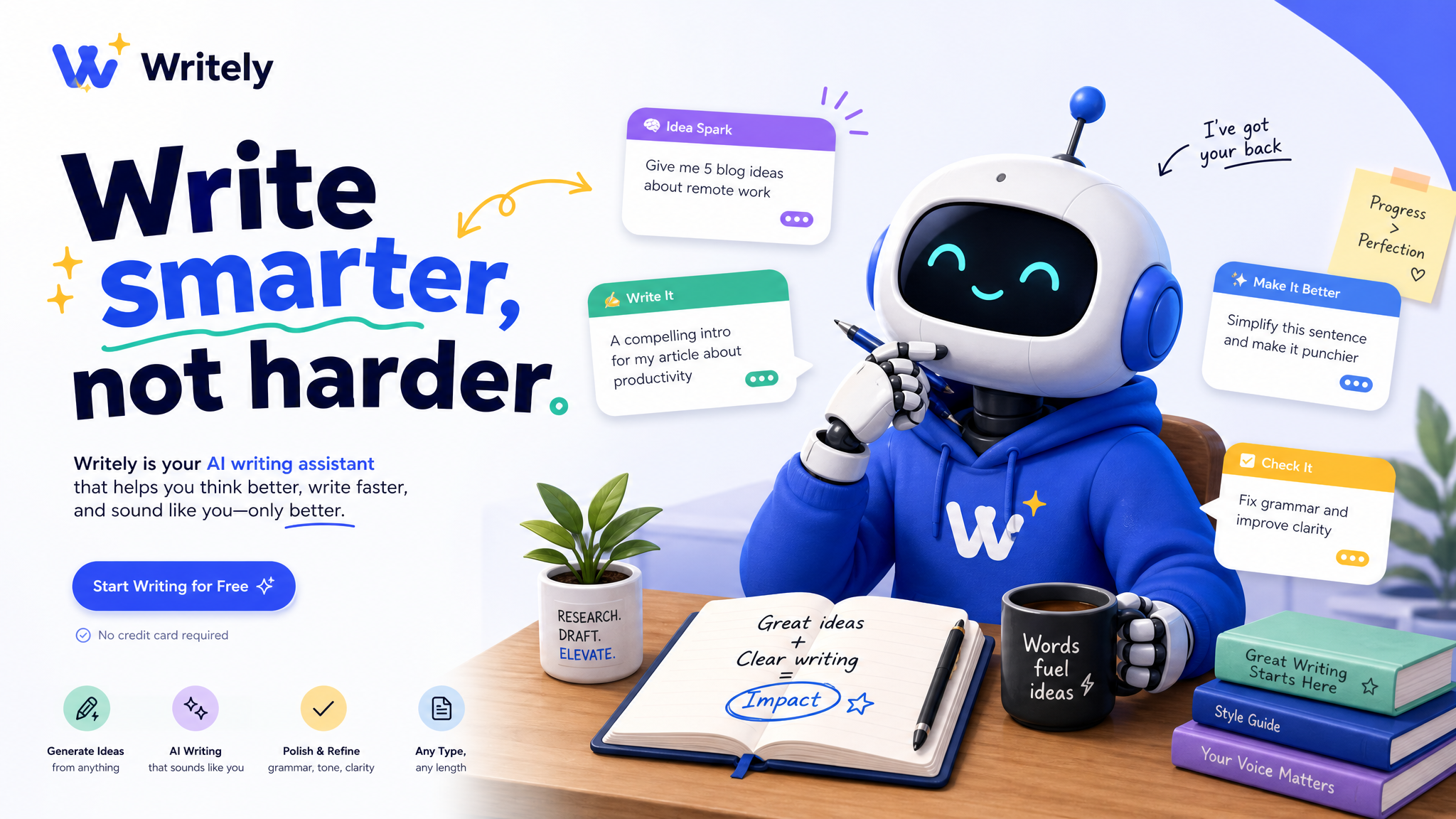
Where the "fun" actually shows up
The product name promises a laugh along. I'll be honest—no AI is going to crack a joke that makes you snort coffee out your nose. But Writely does inject a little personality into its suggestions. Some rewrites come with a slight irreverence or a natural casualness that makes editing feel less like punishment.
This works best for short-form content: social media captions, email newsletters, anything where you want to sound like a person, not a brand manual. When I asked for a more playful version of a product description, it offered alternatives that actually sounded like something I'd say—not a thesaurus explosion.
Is it for you? Here's the tradeoff
Writely isn't trying to be the heavy-duty, everything-including-the-kitchen-sink solution. If you need deep research integration, citation management, or a tool that writes your entire 5,000-word guide from a single keyword, this probably isn't it. For that, you'd look at Jasper or something like a custom GPT setup.
What it does well is take the you that already exists—your messy outline, your half-baked idea, your overly formal first draft—and smooth it into something that reads professionally but still sounds like you. That's rarer than it should be.
One limitation: the export and organizational features are straightforward but not deeply customizable. If you're managing a multi-author blog with complex workflows, you'll likely supplement with other tools. But for an individual writer, a freelancer, or a small team that just wants to draft faster without losing personality, it's a solid fit.
Try it on a piece of content you're stuck on. Not the easy one—the one you've been avoiding. If it unblocks you in ten minutes, you've found your AI writing assistant for the long haul.
Comments
Leave a Comment