You've been planning that blog post for three weeks. You have a folder of research, a color-coded outline, and a title so polished it could sit on a bookstore shelf. But the Google Doc is still empty. The cursor blinks at you, and the longer you stare, the louder the voice gets: It's not ready yet. You need a better structure.
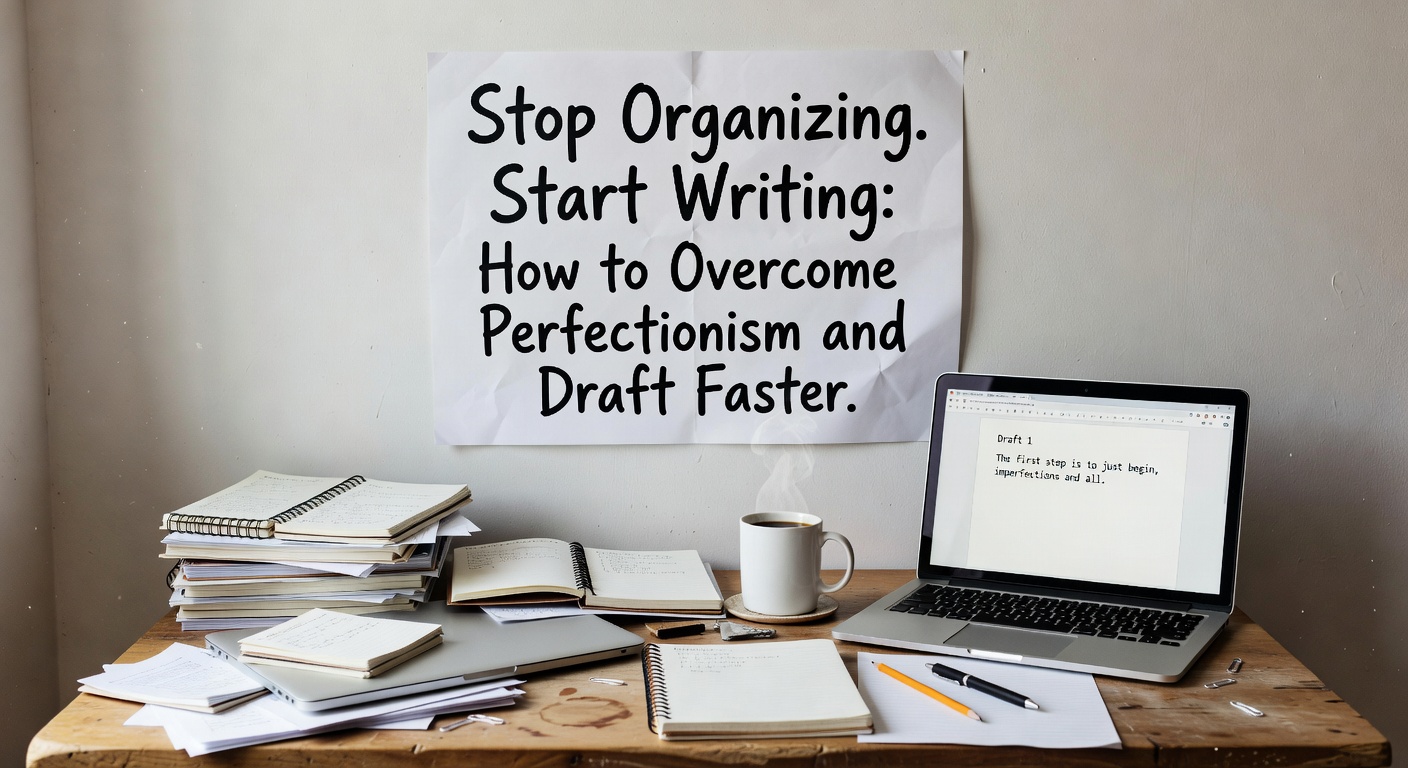
That voice is lying to you. Organizing is not writing. It's just a very convincing form of procrastination dressed up as productivity.
I know because I spent six months building out topic clusters, refining headlines, and categorizing sources for a single pillar page. I had spreadsheets. I had tags. I had nothing published. The moment I actually sat down to draft, I realized I'd already written the post in my head so many times that no real version could ever match the imaginary one. Perfectionism doesn't protect quality. It just prevents output.
The real cost of "getting organized first"
There's a difference between preparation and delay. Good preparation answers one question: What do I need to start? Bad preparation answers infinite questions: What if this section is weak? Should I move this quote? Is the tone too casual for this audience?
That endless loop is expensive. It costs you momentum, reader trust (because you're not publishing), and the feedback loop that actually improves writing. No outline survives first contact with real readers anyway. You can't optimize a draft that doesn't exist.
Writely doesn't fix perfectionism by magic. No tool can. But it changes the starting point. Instead of staring at a blank screen that demands a masterpiece, you paste in a rough idea—a paragraph of notes, a half-baked argument, or even bullet points—and the assistant generates a working draft. A draft that is imperfect, yes, but one you can edit. Editing real text is always faster than conjuring perfect text from thin air.
Three ways to stop organizing and start writing
1. Set a timer and dump
Pick a section. Set 15 minutes. Write everything you know about it—bad grammar, tangents, placeholder jokes, whatever. Do not organize. The goal is not quality. The goal is material. Writely works best when it has something to work with; even messy notes are fuel. I've fed it bullet points like "3rd paragraph needs to explain why SEO isn't dead—reference Google's 2024 update—maybe mention the Reddit case" and gotten back a coherent paragraph I could polish in two passes.
2. Write the middle first
Intros and conclusions are where perfectionism lives. They force you to summarize before you've figured out what you're actually saying. Skip them. Start on the section you understand best—the practical advice, the case study, the how-to steps. By the time you finish that, the rest writes itself because you now know what the piece is really about. I've written whole posts by starting with a single example, then asking Writely to "build an argument around this."
3. Treat your first draft as a mold, not a monument
The most freeing shift is accepting that your first version exists to be rewritten. Not to be admired. Writely helps here because it doesn't get attached to its output. If the generated paragraph is off-tone or too generic, you don't feel the sting of wasted effort—you just re-prompt or edit. That psychological distance is surprisingly effective. The draft is a thing you use, not a thing you are.
Tradeoffs: when organizing actually helps
I'm not saying structure is useless. If you're writing a technical guide with interdependent steps, or a script where timing matters, some upfront planning is necessary. And if you genuinely don't know what you're writing about yet—like you're synthesizing ten research papers—a minimal outline prevents incoherence.
The test is simple: ask yourself if the organizing is producing decisions or just postponing them. If you're still moving Post-it notes after an hour, you're organizing. If you have a clear enough path that you could write a bad version of the first section right now, you're ready. The line isn't crisp, but you'll feel it.
What Writely does differently
Most writing tools assume you already have a plan. They optimize for execution. Writely optimizes for starting. The "rough concept to draft" pipeline is built for people who have ideas but not polished words. You don't need a perfect prompt. You don't need a tone guide. You need something on the page that you can push against.
That's the shift: stop trying to architect the final product before you've written a single sentence. Write the bad version. Fix the bad version. Repeat. The organization will emerge from the act of writing, not the act of planning. And if you need a nudge, paste your scattered thoughts into Writely and see what comes back. It won't be perfect. It will be something. And something always beats a blinking cursor.
Comments
Leave a Comment